
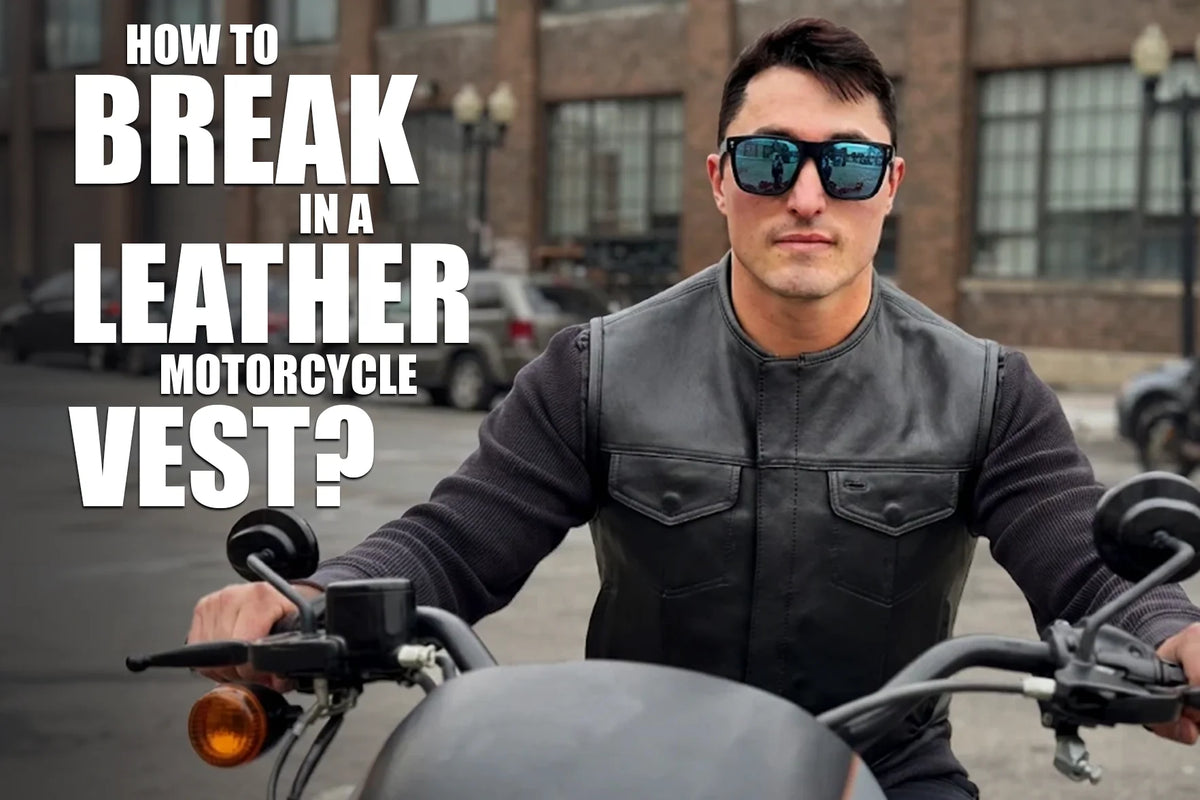
How to Break in a Leather Motorcycle Vest?
To break in a leather motorcycle vest, wear it as often as you can, on rides and off the bike, so your body heat and movement soften the hide where you actually bend. Flex the armholes and shoulders by hand between wears. After the first week or two, add a thin coat of leather conditioner. Most full-grain cowhide vests feel broken in after 2 to 4 weeks of regular wear, while dense horsehide or buffalo can take a full riding season. Skip the shortcuts: soaking, hair dryers, ovens and heavy oiling all damage the leather.
A brand-new vest can feel like wearing a cardboard box. The armholes bite, the collar stands up, and the front panels won't bend when you reach for the bars. That stiffness is actually good news, because dense, tightly packed fibers are what make a quality vest last for decades. Your job is to let those fibers relax and mold to you, without damaging them along the way.
Whether you just picked up one of our mens leather motorcycle vests or you're reviving an old favorite that's gone stiff in the closet, this guide covers the full break-in method, step by step. You'll learn how long each leather takes, how to treat armholes, collars, laces and pockets, and which popular hacks to avoid.
What You'll Need
Breaking in a vest takes more time than tools, but these help:
-
Your vest and your usual riding layers: a T-shirt, flannel or thin hoodie
-
A thick hoodie or sweater for gentle stretching
-
2 soft microfiber cloths: one to apply, one to buff
-
A quality leather conditioner: cream, lanolin or beeswax-based, made for finished full-grain or top-grain leather
-
A soft brush or dry cloth for dusting before you condition
-
A wide, padded hanger to keep the shoulders in shape
-
Optional: a handheld garment steamer and distilled water, for careful spot work on very stiff areas
How to Break in a Leather Motorcycle Vest: Step-by-Step
Step 1: Make Sure the Fit Is Right
Break-in shapes a vest to your body. It doesn't change its size. Leather gives a little across the back and shoulders as it softens, but a vest that strains at the snaps on day one will still strain in month three. Before you put in weeks of wear, check the fit over your usual riding shirt:
-
Shoulders: the seams sit right on the edge of your shoulders, not hanging off or creeping toward your neck.
-
Chest: it closes without a struggle, and you can breathe and reach forward freely.
-
Length: the hem lands at or just above your belt, so it doesn't bunch into your gut when you sit on the bike.
-
Armholes: they don't pinch when you reach for the bars.
Snug vs. too tight: a snug vest feels secure but still lets you move fully. If it pinches under the arms, pulls across your back when you reach, or you have to suck in to close it, it's too small. Break-in won't fix that, so size up. Riders with curves should choose womens leather motorcycle vests, which are cut for women's proportions, rather than a smaller men's pattern. If your vest has side laces, set them now for a comfortable middle position, so you have room to adjust either way.
Step 2: Prep the Vest
-
Read the care label. Manufacturer instructions come first.
-
Brush or wipe off any dust from shipping or the shop floor.
-
Look for loose stitching, pale fold lines or cracks. Cracked leather needs repair, not break-in.
-
Spot test any product you plan to use on a hidden area, like the inside hem or under the armhole, and wait at least an hour.
If the vest is a used one that's actually dirty, clean it before you do anything else. Our guide on how to clean a leather vest safely walks you through it. Conditioner on top of dirt traps grime in the grain.
Step 3: Wear It Everywhere
This is the real method. Leather softens with heat, a little moisture and repeated flexing, and your body supplies all three exactly where they're needed.
-
Start with 1 to 2 hours a day around the house, then build up.
-
Wear it on errands, in the garage, at the shop and over a hoodie in the evening.
-
While you wear it, roll your shoulders, swing your arms, twist at the waist, cross your arms and reach forward.
-
Sit down in it often, so the front panels learn where to crease.
Two to three weeks of daily wear does more than months of weekend-only use.
Step 4: Ride It in Your Riding Position
Whether it's a club cut or an everyday mens leather biker vest, it needs to mold to the way you sit on your bike, not just how you stand. Reaching for the bars stretches the back and shoulders. Leaning into turns works the sides. Sitting in the saddle creases the lower front. Short, frequent rides break in a vest faster than one long trip, but longer rides help it settle into a seated shape.
Step 5: Layer Underneath to Ease Tight Spots
If the vest fits properly but feels a little tight across the chest or shoulders, wear it over a thick hoodie or heavy sweater for 30 to 60 minutes at a time. The extra bulk gently pushes the leather outward without straining the seams. A few sessions over a week or two is enough. Only do this with a vest that fits, not one that's a size too small.
Step 6: Flex the Stiff Spots by Hand
Between wears, treat the vest like a new baseball glove. While you watch TV:
-
Bend and roll the armhole edges between your palms.
-
Gently roll the shoulder seams back and forth.
-
Fold the side panels where they crease when you sit, then smooth them flat.
-
Open and close the front snaps or zipper repeatedly.
-
Fold the collar down along its natural line.
Go slowly. You're repeating the motions that wear would do, just a few hundred cycles ahead of schedule.
Step 7: Condition Lightly, After Week Two
A quality vest leaves the tannery with its oils intact, so hold off on conditioner for the first 1 to 2 weeks. After that, put a dime-sized amount on a cloth and work a thin coat into the shoulders, armholes and side seams. Let it absorb for several hours, then buff off the excess. One application during break-in is usually enough. (The full method is in the conditioner guide below.)
Step 8: Use Steam or Light Dampening Only as a Last Resort
For a vest that's still stubborn after a few weeks, a garment steamer can relax the stiffest spots:
-
Fill it with distilled water and set it to low.
-
Hang the vest on a padded hanger.
-
Hold the steamer 6 to 8 inches away and keep it moving over the armholes or creases, a few seconds at a time.
-
Flex the warm area by hand, or wear the vest while it cools.
-
Let it dry fully at room temperature, then condition lightly.
The leather should feel warm and barely damp, never wet. Never hold the vest over a pot of boiling water, and skip steam entirely on suede, waxed leather or near patches.
Step 9: Add Patches Once It's Settled
Wait until the vest has stopped changing shape before you sew on rockers and club patches. If you sew them on too early, the leather keeps stretching around the stiff, stitched area and puckers. Once it's settled, follow our step-by-step guide on how to sew patches on a leather vest, so the stitching goes into healthy, broken-in leather.
Signs Your Vest Is Broken In
-
You forget you're wearing it.
-
You can reach for the bars with no pull across the shoulders.
-
The collar lies flat against your neck.
-
The armholes no longer rub or bite.
-
The front panels drape naturally when you sit.
-
Soft creases have formed where you bend, and the leather is starting to develop a patina.
How to Break in Each Part of Your Vest
Some areas of a riding vest stay stiff long after the rest has softened. Here's how to target them.
-
Armholes: These rub first and soften last, because the edges are often double-layered or bound. Roll the armhole edges between your palms daily, and give them a little extra conditioner after week two. A soft T-shirt with sleeves stops chafing while they soften.
-
Shoulders and back panel: Reaching for the bars stretches this area most. Shoulder rolls, arm reaches and time in the saddle do the work.
-
Collar: A stiff collar stands up and rubs your neck. Fold it down along its natural line, wear it that way, and condition the fold lightly.
-
Front panels, snaps and zipper: Open and close them often. Sitting in the vest teaches the lower front where to crease.
-
Side laces: Leather laces stiffen and can snap if they dry out. Condition them along with the vest, and loosen them a notch if the sides feel tight while the body softens.
-
Concealed-carry pockets: The holster panel in concealed carry motorcycle vests is often reinforced and stiffer than the rest. Open and close the pocket repeatedly and carry your usual load, so the opening molds to your draw. Don't oil the inside of the pocket.
-
Perforated panels: Perforated leather breaks in a little faster because it flexes more easily. Don't steam or soak it, since moisture collects in the holes.
-
Patch areas: Leave a clean back panel until break-in is done. If your vest already has patches, keep conditioner and steam off the embroidery.
Club-Style and Heavy-Duty Vests
Club cuts are usually made from thicker cowhide, so they're built to carry heavy back patches and rockers. That extra thickness means a slower break-in, often closer to 4 weeks than 2. If you're shopping for a club style motorcycle vest, plan on wearing it daily for a month before sewing on your colors.
How Long Does It Take to Break in a Leather Vest?
Not all leather motorcycle vests break in at the same pace. It depends mostly on the leather and on how often you wear it. A vest worn daily breaks in several times faster than one worn only on weekends.
|
Leather |
Stiffness when new |
Typical break-in |
Good to know |
|
Full-grain cowhide |
Stiff |
2–4 weeks of regular wear |
The classic riding vest leather. Tough, with excellent abrasion resistance. |
|
Naked or drum-dyed cowhide |
Moderate |
1–3 weeks |
Little surface finish, so it softens and develops patina faster. |
|
Top-grain cowhide |
Moderate |
1–2 weeks |
Sanded surface, more flexible from the start. |
|
Buffalo |
Stiff and thick |
Several weeks |
Rugged, pebbled texture and very durable. |
|
Horsehide |
Very stiff |
Up to a full riding season |
Dense and tight-grained. Develops a glossy patina and lasts for decades. |
|
Goatskin |
Moderate |
1–2 weeks |
Softer than cowhide, with good abrasion resistance. |
|
Kangaroo |
Thin but strong |
Short |
Used in performance gear. |
|
Deerskin |
Soft |
Minimal |
Very supple, but less abrasion-resistant for riding. |
|
Lambskin |
Very soft |
Little to none |
Buttery from day one, but scratches easily. |
|
Pigskin |
Moderate |
Short |
Breathable, with visible pores. Often used in gloves. |
|
Suede and nubuck |
Soft |
Minimal |
Use suede products only. Creams mat the nap. |
|
Bonded or faux leather |
Varies |
Doesn't really soften |
Coatings and scrap leather don't break in. |
What Makes One Vest Stiffer Than Another?
-
Thickness: Most riding vests use hides about 1.0 to 1.4 mm thick (roughly 2.5 to 3.5 oz). Thicker hides protect better but take longer to soften.
-
Grade: Full-grain keeps the whole top layer of the hide, so it's the toughest and slowest to break in. Top-grain and genuine leather are sanded or split, which makes them more flexible at first.
-
Tanning method: Vegetable-tanned leather starts firmer than chrome-tanned leather, which feels softer out of the box.
-
Finish: Pigmented or coated finishes add stiffness. Naked and aniline leathers flex sooner.
-
Climate: Leather softens faster in warm, slightly humid weather. In cold, dry climates it stays rigid longer.
-
How you store it: A vest folded in a drawer or kept in a hot car stays stiff. Hang it up between wears.
Does Leather Conditioner Help Break in a Vest?
Yes, but it's a helper, not a shortcut. Conditioner replaces the fats that let leather fibers slide past each other, so the vest flexes and drapes instead of creasing into hard folds. Wear and body heat still do the actual shaping.
When to Condition a New Vest
Wait 1 to 2 weeks. A new vest comes from the tannery with its oils and finish intact. Conditioning too early oversaturates the hide and can leave it greasy and limp.
The dryness test: press your thumb into a flat panel and let go. Healthy leather springs back. Dry leather holds the dent. Fine pale lines when you gently fold a corner are another sign the hide needs conditioning.
How to Apply Conditioner
-
Brush or wipe off any dust.
-
Put a dime-sized amount on a clean, soft cloth, never straight onto the vest.
-
Work it in with thin circular strokes across a whole panel, so you don't get blotchy patches.
-
Focus on the high-flex areas: shoulders, armholes, side seams and collar fold.
-
Keep it off the lining, patches, snaps and zippers.
-
Let it absorb for several hours or overnight.
-
Buff off the excess with a dry cloth. The leather should look nourished and matte, not shiny or greasy.
Judge the result the next day, and repeat only if needed.
Which Product to Choose
|
Product |
Best for |
Trade-offs |
|
Cream or lotion conditioner |
Most new vests |
Light, absorbs well, rarely darkens leather. |
|
Lanolin or beeswax balm |
Stiff edges, armholes, seams |
Adds water resistance. Warm it between your hands, not with a hair dryer. |
|
Leather softening spray |
Quick, even light coats |
Gentle, but follow the label and patch test. |
|
Leather care kit (cleaner + conditioner + cloth) |
Beginners |
Takes out the guesswork. Brands like Lexol, Leather Honey, Chamberlain's Leather Milk and Bick 4 make kits for finished leather. |
|
Neatsfoot or mink oil |
Very dry, oil-tanned or vintage leather |
Softens deeply but darkens leather and can make a vest limp. Use sparingly. |
|
Coconut, olive or jojoba oil |
Not recommended |
Not made for leather. Food oils can go rancid, leave residue and attract dirt. |
Avoid conditioners that contain silicones, petroleum distillates or alcohol. They clog the grain or dry it out.
How Often to Condition
Once during break-in is usually enough, with a second light coat a month or two later if the vest still feels dry. After that, condition every 3 to 6 months for regular riders, or once or twice a year if you ride occasionally.
Break-In Mistakes and Myths That Ruin Leather Vests
Most leather vests that end up cracked or misshapen weren't worn out. They were rushed. Every shortcut trades leather life for speed, so skip these:
-
Soaking the vest or "wet break-in." Soaking it, or wearing it until it's drenched, strips oils. It dries stiff, blotchy and prone to cracking. Getting caught in the rain won't ruin a vest, but don't do it on purpose.
-
Hair dryers, heat guns, ovens and hot car dashboards. Dry heat cooks leather fibers and leads to shrinkage and cracks. That includes "heat-activating" balm with a hair dryer.
-
Steaming over a pot of boiling water. Uncontrolled steam water-marks and warps the hide. If you steam at all, use a garment steamer on low, at a distance.
-
Sunbathing the vest before oiling. Sunlight doesn't "open the pores." It fades the dye and dries the leather.
-
Rubbing alcohol and Vaseline. Alcohol strips dye and natural fats. Petroleum jelly leaves a greasy film that darkens leather and attracts dirt. It may feel softer for a day, then worse.
-
Cooking oils. Olive and coconut oil can go rancid and darken leather unevenly.
-
Over-oiling to speed things up. Too much oil leaves you with a soft, limp vest that has no structure.
-
Rolling pins, mallets, sitting on it or driving over it. Concentrated crushing breaks fibers instead of relaxing them.
-
Tumble drying. Heat plus tumbling is the fastest way to ruin a vest.
-
Folding or balling it up. Hard folds leave permanent creases. Hang it on a wide hanger.
-
Forcing a vest that's too small. Stretching leather past its limit splits seams and tears armholes.
-
Sewing patches on too early. The leather keeps moving under them and puckers.
Troubleshooting Common Break-In Problems
|
Problem |
Why it happens |
Fix |
|
Armholes chafe |
Stiff, bound edges |
Flex the edges daily, condition them, and wear a sleeved T-shirt until they soften |
|
Collar stands up |
Thick collar leather |
Fold it along its line, wear it folded, condition the fold |
|
Tight across the chest |
Snug fit |
Layer a hoodie for short sessions and loosen the side laces |
|
Leather squeaks |
Dry fibers rubbing together |
A light coat of conditioner |
|
White lines in the folds |
Dryness |
Condition, then keep wearing |
|
Stiff again after rain |
Oils pulled out as it dried |
Air dry at room temperature, then condition lightly |
|
Still too tight after a month |
Wrong size |
A leather tailor can let out the side seams or add lacing, or size up |
How to Soften an Old, Stiff Leather Vest
A vest that's spent years in a closet often feels like cardboard because it's dried out, not because it was never broken in.
-
Inspect it for cracks, mold and loose stitching.
-
Clean it gently and let it dry fully.
-
Do the thumb-press dryness test.
-
Apply a thin coat of conditioner, let it absorb overnight, and buff.
-
Repeat once or twice over a week if it's very dry.
-
Wear it and flex it by hand, just like a new vest.
If the leather is already cracking, or it's a valuable or vintage horsehide piece, take it to a leather restoration specialist.
How to Care for Your Vest After It's Broken In
Well-kept motorcycle leather vests can last for decades. You've earned that custom fit, so protect it:
-
Keep wearing it. A vest in regular use stays supple.
-
Condition every 3 to 6 months, and only when the leather feels dry.
-
Wipe it after rides with a dry cloth to remove dust and sweat. If it starts to smell, see our guide on how to get odor out of a leather jacket or vest.
-
Dry it right. If it gets wet, blot it and hang it to dry at room temperature, then condition lightly.
-
Store it on a wide, padded hanger in a cool, dry closet, inside a breathable cotton bag. Never use plastic or fold it, and aim for about 40 to 50 percent humidity.
-
Inspect it each season for loose stitching, worn laces and tired snaps.
Real Leather vs. Faux, Textile and Mesh Vests
Breaking in is really a genuine-leather process. Real leather softens, molds to your body and develops a patina over time.
-
Faux or vegan leather (PU or PVC): starts soft and never gets softer. Heat, oil and alcohol can make the coating peel or crack.
-
Bonded leather: made from leather scraps and binders. It can turn brittle and won't mold the way real hide does.
-
Textile and mesh vests: need little break-in beyond a few wears and adjusting the straps. Follow the label for washing.
Final Thoughts:
A stiff new vest isn't a problem. It's the start of the best-fitting piece of gear you'll ever own. Start with the right size, wear it everywhere, flex the tight spots by hand, and add a light coat of conditioner once the first couple of weeks have passed. Skip the soaking, the heat and the heavy oil. In a few weeks, your vest will move with you instead of against you, and it'll fit nobody else quite the same way.
That payoff starts with leather worth the effort. At Unik International, we build vests for riders who put in real miles. They're cut for the saddle, made from hides that soften into a true second skin, and tough enough to carry your colors for years.
Wear it. Ride it. Make it yours. Unik for Riding.
Frequently Asked Questions
How long does it take to break in a leather motorcycle vest?
Most full-grain cowhide vests take 2 to 4 weeks of regular wear. Horsehide and thick buffalo can take a full riding season, while lambskin and deerskin need almost none. Wearing it daily is what speeds it up.
What is the fastest way to break in a leather vest?
Wear it every day, on and off the bike, and flex the armholes and shoulders by hand between wears. After week two, add a thin coat of conditioner. Shortcuts like soaking or heat damage the leather.
Should I condition a new leather vest right away?
No. Wait 1 to 2 weeks, because new leather already has its tannery oils. Then apply a thin coat to the shoulders, armholes and seams.
Can I get a leather vest wet to break it in?
Don't soak it. Water strips oils and leaves the leather stiff and blotchy as it dries. If you need extra help, a garment steamer used lightly at a distance is safer. If you get caught in the rain, air dry the vest and condition it afterward.
Can I use a hair dryer to soften a leather vest?
No. Even on low, direct heat dries the leather and can cause cracks. Your body heat is the only heat a vest needs.
Will a leather vest stretch as it breaks in?
Only a little, across the back and shoulders. It won't grow a full size. If it strains at the snaps when new, it's too small.
My new vest feels like cardboard. Is that normal?
Yes. Stiffness usually means dense, durable leather. Keep wearing it and flexing it, and it'll soften.
Does horsehide take longer to break in than cowhide?
Yes. Horsehide is denser and stiffer, and it can take a full season. It rewards that patience with a glossy patina and a very long life.
Can I use mink oil, olive oil or coconut oil?
Mink and neatsfoot oil soften leather but darken it and can make a vest limp, so use them sparingly. Avoid cooking oils, which can go rancid. A cream conditioner made for leather is the safer choice.
Do alcohol and Vaseline soften leather?
They may feel softer for a day, but alcohol strips dye and natural fats, and Vaseline leaves a greasy, dirt-attracting film. Skip both.
When should I sew patches onto a new vest?
After it's fully broken in and has stopped changing shape, usually after 2 to 4 weeks of regular wear for cowhide. Sewing them on earlier can cause puckering.
How do I know my vest is broken in?
You forget you're wearing it. The collar lies flat, the armholes don't rub, and you can reach for the bars without any pull across the shoulders.
Can I break in a vest that's too small?
Not really. Layering and side laces can buy a little room, but leather won't stretch a full size. A leather tailor can sometimes let out the seams, but sizing up is usually the better fix.