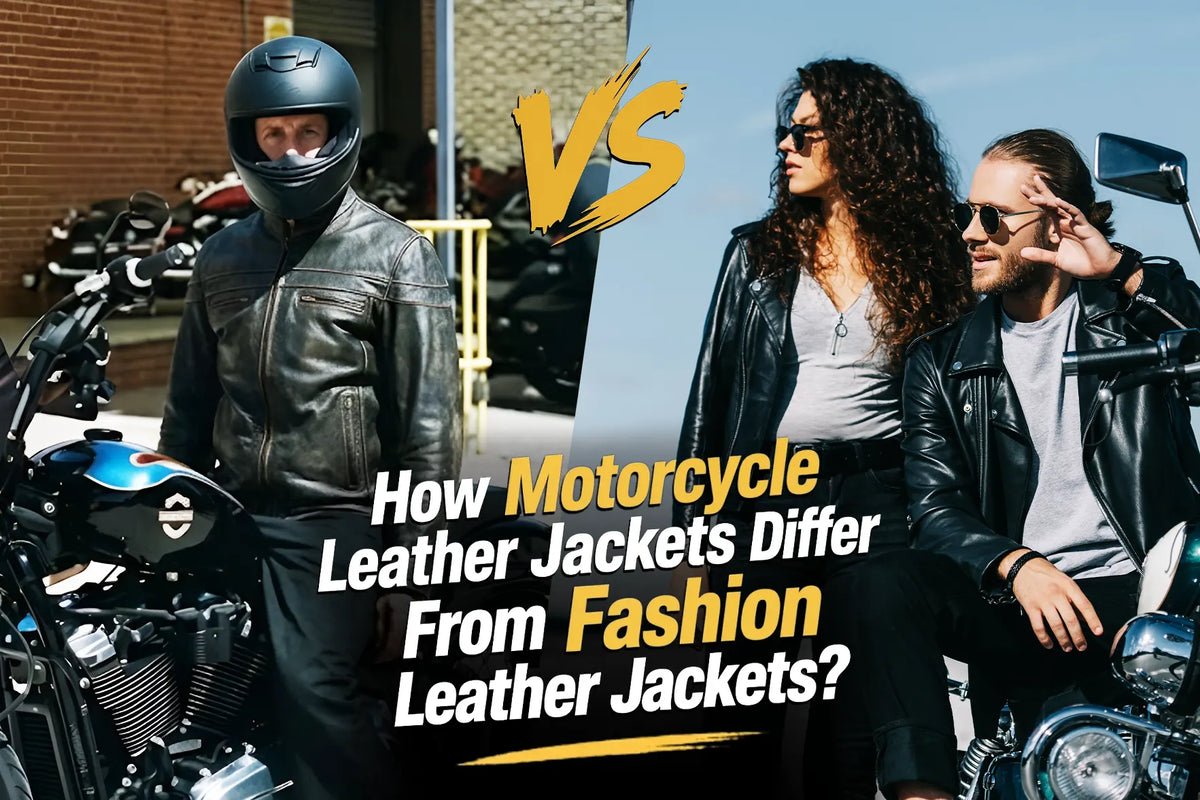
Motorcycle leather jackets differ from fashion leather jackets in what they're built to do. A riding jacket is protective gear. It uses thick, abrasion-resistant cowhide (about 1.2 to 1.4 mm), double- or triple-stitched seams, and impact armor at the shoulders, elbows and back, ideally CE-rated to EN 1621. It's cut for the riding position, with pre-curved sleeves and a longer back. A fashion leather jacket is everyday clothing. It usually uses thinner, softer lambskin or sheepskin under 1 mm, standard stitching, no armor, and a cut made for standing and walking. They can look identical on a hanger, but only one is designed to keep you in one piece on the road.
The confusion is understandable. Both share the same asymmetric zip, snap-down lapels, belted waist and attitude, because the fashion jacket borrowed its look from riders. But a jacket that looks the part at a rally isn't always built for a slide across asphalt at 40 mph.
This guide from the Unik team breaks down every real difference: leather, armor, CE ratings, stitching, fit, hardware, linings, weight and price. It also covers the history behind the look, how to spot a true riding jacket in under a minute, and which one belongs in your closet. If you're shopping for mens leather motorcycle jackets, it'll help you know exactly what you're paying for.
Motorcycle vs Fashion Leather Jacket: Side-by-Side Comparison
|
Feature |
Motorcycle leather jacket |
Fashion leather jacket |
|
Main purpose |
Rider protection, then style |
Style and everyday comfort |
|
Leather |
Full-grain or top-grain cowhide, buffalo, kangaroo or horsehide |
Lambskin, sheepskin, goatskin, nappa, faux or bonded leather |
|
Thickness |
About 1.2–1.4 mm |
Usually 0.6–1.0 mm |
|
Impact armor |
Shoulders, elbows and back (built in or via pockets) |
None |
|
Safety standards |
Armor to EN 1621; garment to EN 17092 (AAA to C) |
None |
|
Seams |
Double or triple stitched, often with safety seams |
Single, standard stitching |
|
Thread |
Heavy bonded nylon or polyester, sometimes aramid |
Standard cotton or polyester |
|
Cut |
Pre-curved sleeves, longer back, action back or gussets |
Straight sleeves, cropped or tailored body |
|
Fit |
Snug, so armor stays in place |
Relaxed or tailored for the look |
|
Hardware |
Heavy-duty zippers, zippered cuffs, waist adjusters, snap collar |
Lighter or decorative zippers and buckles |
|
Lining |
Zip-out thermal liner, mesh, quilted satin |
Thin fashion lining |
|
Ventilation |
Zip vents or perforated panels |
Rarely |
|
Weather protection |
Wind flaps, water-resistant treatment, storm collar |
Minimal |
|
Weight |
Heavy and structured |
Light, soft drape |
|
Break-in |
Weeks of wear |
Little or none |
|
Price drivers |
Heavy hide, armor, testing, reinforced build |
Leather softness, finish, brand |
|
Best for |
Riding on public roads |
Street style, work and nights out |
The Key Differences Between Motorcycle and Fashion Leather Jackets
1. Purpose: Protection vs. Presentation
In a crash, a rider faces two threats: impact, when bones and joints hit the ground, and abrasion, the long slide that grinds through clothing and skin. Every feature of a real motorcycle jacket exists to deal with one of those two forces. A fashion jacket is designed around a completely different brief: how it drapes, how it feels, and how it looks with jeans or a dress. Neither is wrong. They just solve different problems.
2. Leather Type and Thickness
This is where the two jackets split first.
|
Features |
Motorcycle jacket |
Fashion jacket |
|
Common hides |
Cowhide, buffalo, kangaroo, horsehide |
Lambskin, sheepskin, goatskin, nappa, deerskin |
|
Typical thickness |
1.2–1.4 mm |
0.6–1.0 mm |
|
Grade |
Full-grain or top-grain |
Often top-grain, corrected grain, genuine or bonded |
|
Feel when new |
Stiff and structured |
Soft, buttery and drapey |
|
Ageing |
Breaks in and develops a patina |
Can scuff, stretch or wear thin faster |
Cowhide is the classic riding leather because its dense fiber structure holds up to sliding. Kangaroo is thinner but very strong for its weight, so it's popular in race suits. Horsehide and buffalo are heavy and very durable. Lambskin feels wonderful, but it's thin and soft, so it can wear through quickly on asphalt.
Thickness isn't the whole story. Tanning, finishing and grade matter too. Full-grain leather keeps the strongest top layer of the hide. Top-grain is sanded smooth. "Genuine" and bonded leathers are lower grades. Naked or aniline leather keeps the natural grain open, while pigmented and coated leather has a protective topcoat. Faux or PU leather is plastic over fabric, and it offers almost no abrasion resistance.
For a deeper look at hides, grades and finishes, see Leather Jackets Explained: Types, Materials, and Styling Tips.
3. Impact Armor
Open a proper riding jacket and you'll find armor, or at least armor pockets, at the shoulders, elbows and back. Some jackets also take chest protectors. A fashion jacket has none, and soft comfort padding is not armor.
Riding armor is tested to the European standard EN 1621:
|
Standard |
Covers |
Level 1 (mean transmitted force) |
Level 2 (mean transmitted force) |
|
EN 1621-1 |
Shoulders, elbows, hips, knees |
Under 35 kN |
Under 20 kN |
|
EN 1621-2 |
Back |
Under 18 kN |
Under 9 kN |
|
EN 1621-3 |
Chest |
Rated separately |
Rated separately |
|
EN 1621-4 |
Inflatable (airbag) protectors |
Rated separately |
Rated separately |
The lower the force that passes through to your body, the better, which is why Level 2 is the more protective rating. Modern armor is usually soft viscoelastic foam that stiffens on impact, or a hard shell over foam.
If your jacket has empty armor pockets, you can upgrade it with CE-rated motorcycle armor pads. Just remember that armor slipped into a fashion jacket doesn't turn it into riding gear. The pockets, the shell and the fit have to work together as a system.
4. Safety Certification: CE and EN 17092
Armor gets its own rating, but the whole garment can be tested too, under EN 17092. Jackets are put through abrasion, seam-strength and tear tests, then given a class:
|
EN 17092 class |
What it means |
|
AAA |
Highest abrasion and impact protection, for sport and high-speed riding |
|
AA |
Strong all-round protection for touring and commuting |
|
A |
Lighter protection with more comfort, for urban riding |
|
B |
Abrasion protection without impact armor |
|
C |
An armor carrier (like an armored base layer) worn under or over other clothing |
A garment with a CE class will say so on its label, with the pictogram and class letters. A fashion jacket carries no class, because it was never designed or tested to pass one. In the US, there's no legal requirement for riding jackets to be certified. Many classic cruiser-style jackets rely on thick leather and armor pockets rather than a full EN 17092 rating, so always read the label or listing.
5. Stitching and Seams
A jacket is only as strong as its weakest seam. If a seam bursts in a slide, the leather around it can't protect you.
-
Motorcycle jackets use double or triple stitching at high-stress zones: the shoulders, elbows, underarms and side panels. Many add safety seams, folded or hidden seams that protect the thread from touching the road. They also use heavy bonded nylon or polyester thread, and sometimes aramid (Kevlar-type) thread.
-
Fashion jackets use single, exposed seams with standard thread. They're fine for everyday wear but can split open under crash loads.
6. Cut and Fit: Riding Position vs. Mirror Position
A fashion jacket is cut to look right while you stand with your arms at your sides. A riding jacket is cut for a body leaning forward with its arms reaching for the bars.
-
Pre-curved sleeves follow the bend of your arms on the grips, so the cuffs don't ride up past your wrists.
-
A longer or dropped back keeps your lower back covered when you're tucked over the tank.
-
Action backs, accordion stretch panels and shoulder gussets let you rotate your shoulders without the jacket pulling.
-
A snug fit keeps the armor sitting over your joints. Loose armor slides out of place in a crash.
-
Adjustable waist tabs and belts stop the jacket billowing at highway speed.
To test the fit, zip the jacket fully, sit as you would on your bike and reach forward. The sleeves should still cover your wrists, and the back shouldn't ride up. If standard sizes don't suit your build, a custom-built motorcycle jacket made to your measurements solves it.
7. Hardware and Closures
On a riding jacket, the hardware has a job:
-
Heavy-duty metal zippers, often YKK, that stay shut under load
-
Zippered or snap cuffs that close over glove gauntlets and seal out wind
-
A snap-down collar and lapels that don't flap at speed
-
Wind flaps behind the main zipper
-
A waist connection zipper on some jackets, to join matching riding pants
-
Concealed-carry and deep zippered pockets that won't spill on the road
Fashion jackets often copy these details, but with lighter, decorative zippers, thinner pocket bags and buckles that are just for show.
8. Lining, Ventilation and Weather Protection
Riders deal with everything from 40°F mornings to 95°F afternoons, so riding jackets are built to adapt:
-
A zip-out thermal liner for cold rides
-
Mesh or quilted satin linings, depending on the season
-
Zippered vents or perforated leather panels for airflow
-
Water-resistant finishes and a storm collar
-
Reflective piping, on some models, for night visibility
A fashion jacket usually has a thin fixed lining. It blocks a breeze, but it isn't designed for wind chill at 60 mph.
9. Weight and Comfort
Thick hide, armor and reinforced seams add weight, so a riding jacket can weigh noticeably more than a fashion jacket. It also starts stiff and takes a few weeks of wear to mold to your body. A fashion jacket is light, soft and comfortable from day one. That's exactly why it's the better choice for walking around town all day.
10. Price and Value
A riding jacket costs more because you're paying for heavier hide, armor, testing and more labor in the seams. A fashion jacket's price goes into leather softness, finish and the brand name. Be wary of a "protective" jacket at a fashion-jacket price, because the expensive parts are the ones that protect you. Paying riding-gear prices for an uncertified style piece is poor value too.
Look after either one and it'll last for years. Our guide on how to clean a leather jacket covers the routine. If your riding jacket picks up sweat, smoke or a musty storage smell, here's how to get odor out of a leather jacket.
11. Style Details That Started as Function
Many fashion details began as riding features:
|
Detail |
Original riding purpose |
|
Asymmetric front zip |
Keeps the zipper away from the throat when the collar is folded, and lets the front overlap to seal out wind |
|
Snap-down lapels |
Stop the collar flapping in the face at speed |
|
Waist belt |
Cinches the jacket so it doesn't ride up or balloon |
|
Zippered cuffs |
Make room for gloves and close out wind |
|
Epaulets |
Held gloves or straps in place, a detail from military flight jackets |
|
Angled chest pockets |
Easy to reach while seated on the bike |
|
Quilted shoulders |
Extra padding and flex across the shoulders |
How the Biker Jacket Became a Fashion Icon
The two jackets share a family tree, which is exactly why they're so easy to mix up.
-
Early 1900s: Pilots and dispatch riders wear heavy horsehide and goatskin jackets for wind and cold.
-
1928: Schott NYC creates the Perfecto, an asymmetric-zip cowhide jacket sold through a Harley-Davidson dealer. It sets the template for the biker jacket.
-
1953: Marlon Brando wears a Perfecto in The Wild One, and James Dean's leather look follows. The jacket becomes a symbol of rebellion.
-
1960s: London's café racer crowd, the "ton-up boys," popularize the slim, collarless café racer jacket.
-
1970s–1980s: Punk and rock bands take the biker jacket from the road to the stage.
-
Today: Fashion houses and high-street brands sell biker-style jackets in lambskin and faux leather. Meanwhile, riding gear has added CE armor, EN 17092 testing and technical linings.
Over almost a century, the look and the protection split into two separate products that still share the same silhouette. Today's mens leather biker jackets still carry that Perfecto DNA, but only the ones built with riding-weight hide, armor and a riding cut honor its original purpose.
Popular Leather Jacket Styles: Riding vs. Fashion Versions
|
Style |
Riding version |
Fashion version |
|
Asymmetric biker (Perfecto) |
Thick cowhide, armor pockets, belted waist, snap lapels |
Lambskin, cropped cut, decorative zips and studs |
|
Café racer |
Slim, collarless, pre-curved sleeves, armor |
Minimal and slim, but no armor or riding cut |
|
Cruiser or classic |
Heavy cowhide, zip-out liner, vents, concealed-carry pockets |
Rarely made as a fashion piece |
|
Sport or race |
Kangaroo or cowhide, hard sliders, speed hump, often AAA rated |
Racing stripes and logos for the look |
|
Touring |
Waterproof liner, many vents, long back |
Rarely made as a fashion piece |
|
Bomber or flight |
Rarely armored |
Shearling collar, ribbed cuffs, casual fit |
So when you see the words "moto," "biker-style" or "rider-style" on a product page, check the specs. The style name alone tells you nothing about protection.
Can You Ride a Motorcycle in a Fashion Leather Jacket?
You can put one on and ride, but it isn't real protection. It's better than a T-shirt, but that's a very low bar for something as unforgiving as asphalt. Here's what goes wrong in a fall:
-
No impact absorption. Without armor, the force goes straight into your shoulders, elbows and spine.
-
Fast wear-through. Thin lambskin can grind through in a short slide, exposing skin to road rash.
-
Seams that burst. Standard single stitching can split open on impact.
-
Ride-up and shifting. A loose or cropped fit moves out of place, leaving your back and wrists uncovered.
Even a low-speed spill can cause serious injury. Wearing an armored shirt or a standalone back protector underneath helps with impact, but it doesn't fix thin leather or weak seams. If you ride regularly, and especially on highways, wear a jacket built for it, along with a DOT-approved helmet, riding gloves, boots and riding pants.
Going the other way works fine: you can wear a motorcycle jacket off the bike. It's just heavier and more structured than a fashion piece. For outfit ideas, from jeans and boots to smarter looks, see our guide on what to wear with a leather biker jacket.
Leather vs. Textile Motorcycle Jackets
Riding jackets aren't only made of leather. Textile jackets, made from Cordura, ballistic nylon or mesh, are a popular alternative.
|
|
Leather riding jacket |
Textile riding jacket |
|
Abrasion resistance |
Excellent, especially thick cowhide or kangaroo |
Good to very good, depending on fabric weight |
|
Weather |
Wind-blocking; needs treatment for rain |
Often waterproof with a membrane |
|
Breathability |
Needs vents or perforation |
Mesh versions breathe very well |
|
Weight |
Heavier |
Lighter |
|
Lifespan |
Decades with care, and it develops a patina |
Fabric and coatings wear out sooner |
|
Look |
Classic, works on and off the bike |
Technical, more sporty |
That's why leather motorcycle jackets remain the favorite for cruiser, café and classic riders who want protection that also looks good off the bike.
Women's Motorcycle Jackets vs. Fashion Jackets
Many women buy their first riding jacket for the look, and only discover later that it's a fashion piece. A real women's riding jacket is shaped at the bust, waist and hips, so the armor sits squarely over the shoulders and elbows instead of shifting. Look for the same features as a men's riding jacket: thick leather, armor pockets, reinforced seams, pre-curved sleeves and adjustable waist tabs. Purpose-cut womens leather motorcycle jackets give you that protective structure without forcing you into a men's pattern.
How to Tell a Real Motorcycle Jacket From a Fashion Jacket in 60 Seconds
Not all motorcycle jackets are created equal, and not every "biker" jacket is one. Run through this checklist in the store or on a product page:
-
Check the label for a CE pictogram and an EN 17092 class (AAA, AA, A, B or C).
-
Look for armor at the shoulders, elbows and back, or at least pockets for it. Check that the armor carries an EN 1621 level.
-
Feel the weight. A riding jacket feels substantial in your hand.
-
Check the leather thickness. It should be about 1.2 mm or more, and full-grain or top-grain cowhide, buffalo or kangaroo.
-
Inspect the seams at the shoulders, elbows and underarms for double or triple stitching.
-
Try the riding test. Sit, reach forward and check that the sleeves still cover your wrists and the back doesn't ride up.
-
Test the hardware. Zippers should be heavy metal, cuffs should zip or snap shut, and there should be waist adjusters.
-
Read the wording. "Biker-style," "moto-inspired" or "rider-style" usually means a fashion piece. Riding gear lists its armor and construction details.
Which Jacket Should You Buy?
Choose a motorcycle leather jacket if:
-
You ride on public roads, even for short trips
-
You ride highways, tour, or ride in all seasons
-
You want one jacket that protects you on the bike and still looks great off it
Choose a fashion leather jacket if:
-
You don't ride, and you love the biker look
-
You want something light, soft and comfortable from the first wear
-
You're dressing for the city, the office or a night out
Plenty of riders own both: a protective jacket for the bike and a softer one for everyday wear. The only wrong buy is the one where you expect a fashion jacket to protect you.
Final Thoughts:
A motorcycle leather jacket and a fashion leather jacket can share the same zip, the same lapels and the same attitude, but they're built for completely different days. One is made to look good on the sidewalk. The other is made to stand between you and the asphalt. Thick hide, real armor, reinforced seams and a riding cut are what separate the two, not the silhouette.
At Unik International, we build our leather for the second kind of day. Our jackets are made for riders who actually ride: cut for the saddle, built from riding-weight hides, and designed to keep that classic look whether you're carving canyon roads or walking into the bar at the end of the run. Always check each product listing for its armor and features, and pair your jacket with CE-rated pads for full protection.
Frequently Asked Questions
What is the main difference between a motorcycle jacket and a fashion leather jacket?
Purpose. A motorcycle jacket is protective gear, with thick abrasion-resistant leather, reinforced seams, impact armor and a riding cut. A fashion leather jacket is clothing designed for looks and comfort, with thinner leather and no armor.
Can I ride a motorcycle in a regular leather jacket?
You can, but it isn't adequate protection. Most regular leather jackets lack armor, use thin leather and have standard seams that can split in a slide. Wear a purpose-built riding jacket.
Do fashion leather jackets have armor?
No. Some have light padding for shape, but padding isn't impact armor. Real armor is rated to EN 1621 and sits in pockets at the shoulders, elbows and back.
What does CE-rated mean on a motorcycle jacket?
It means the armor or the whole jacket passed European safety tests. Armor is rated under EN 1621 (Level 1 or Level 2). Whole garments are rated under EN 17092, in classes AAA, AA, A, B or C.
What is the difference between Level 1 and Level 2 armor?
Level 2 lets less force through to your body. For elbows and shoulders, Level 1 must transmit under 35 kN on average and Level 2 under 20 kN. For back protectors, it's under 18 kN and under 9 kN.
How thick should leather be on a motorcycle jacket?
About 1.2 to 1.4 mm for cowhide. Fashion jackets often use leather under 1 mm, which wears through much faster in a slide.
Is a thicker leather jacket safe for riding?
Thicker leather resists abrasion better, but thickness alone isn't enough. Without armor, reinforced seams and a riding fit, a thick fashion jacket still isn't protective gear.
Is lambskin good for motorcycle jackets?
Not really. Lambskin is soft and light but thin, so it wears through quickly. Cowhide, buffalo and kangaroo are the riding standards.
Can I add armor to a fashion leather jacket?
You can wear an armored shirt or back protector underneath, but that won't make a fashion jacket into riding gear. Armor works best in properly placed pockets, inside a jacket that has the right shell, seams and fit.
Why are motorcycle jackets more expensive?
Heavier hides, armor, certification testing and reinforced construction all add cost. With a fashion jacket, you're mostly paying for leather softness, finish and the brand.
Is a biker jacket the same as a motorcycle jacket?
Not always. "Biker jacket" often describes the style: an asymmetric zip, lapels and a belt. A motorcycle jacket is defined by its protective construction. Check the specs, not the name.
Can I wear a motorcycle jacket as a fashion jacket?
Yes. Classic riding jackets look great off the bike. They're just heavier and more structured than a fashion piece.
Are leather or textile motorcycle jackets better?
Leather offers excellent abrasion resistance and a classic look that lasts for decades. Textile is lighter, often waterproof and easier to ventilate. Choose based on your riding style and climate.